


When we contemplate the horizon from Ibiza or Formentera, it is easy to find small silhouettes emerging from the Mediterranean.
These are the numerous islets that surround the Pitiusas, some of which have become icons of the landscape and others much more unknown.
Solitary lighthouses, unique species, spectacular seabeds and legends of pirates and corsairs are hidden in these small territories.
We embark on a journey to learn about some of the most surprising!
The islets of the north and east of Ibiza
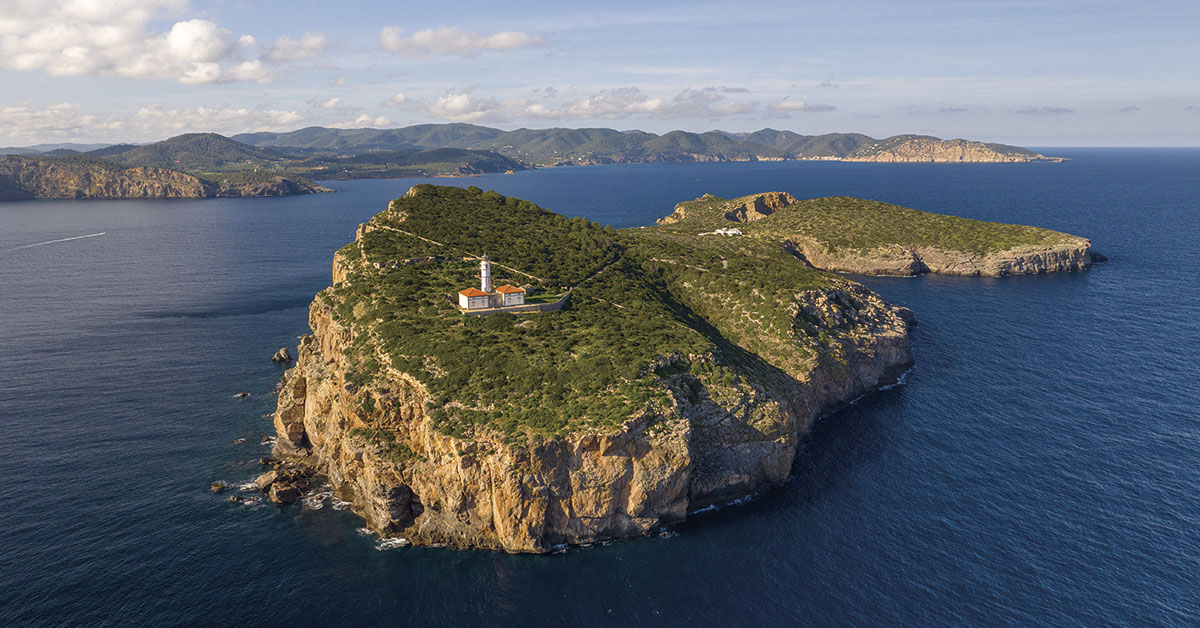
Tagomago, guardian of the eastern coast
In front of Santa Eulària we find Tagomago, one of the most recognisable islets in the east of Ibiza. With more than 1.5 kilometres in length, its rocky silhouette can be seen from places such as Pou des Lleó or Es Figueral.
One of its most characteristic elements is its lighthouse, built in 1913 and located at the southeastern end.
Even its name takes us back centuries, as its possible etymology has been related to Magón Barca, Hannibal's brother, although during the Muslim era it was known as Taj Umayu.
Ses Margalides, two giants between cliffs
In front of the impressive cliffs of Es Amunts emerge Ses Margalides, formed by two islets: Es Picatxo and Na Foradada.
The latter is unmistakable because of the enormous natural arch that crosses its base, under which small boats without masts can pass. In addition, Euphorbia margalidiana grows there, a unique plant linked to this tiny corner of the Pitiusas.
Its seabed is also one of the most appreciated underwater landscapes by diving enthusiasts.
The Illots de Ponent: nature, lighthouses and legends
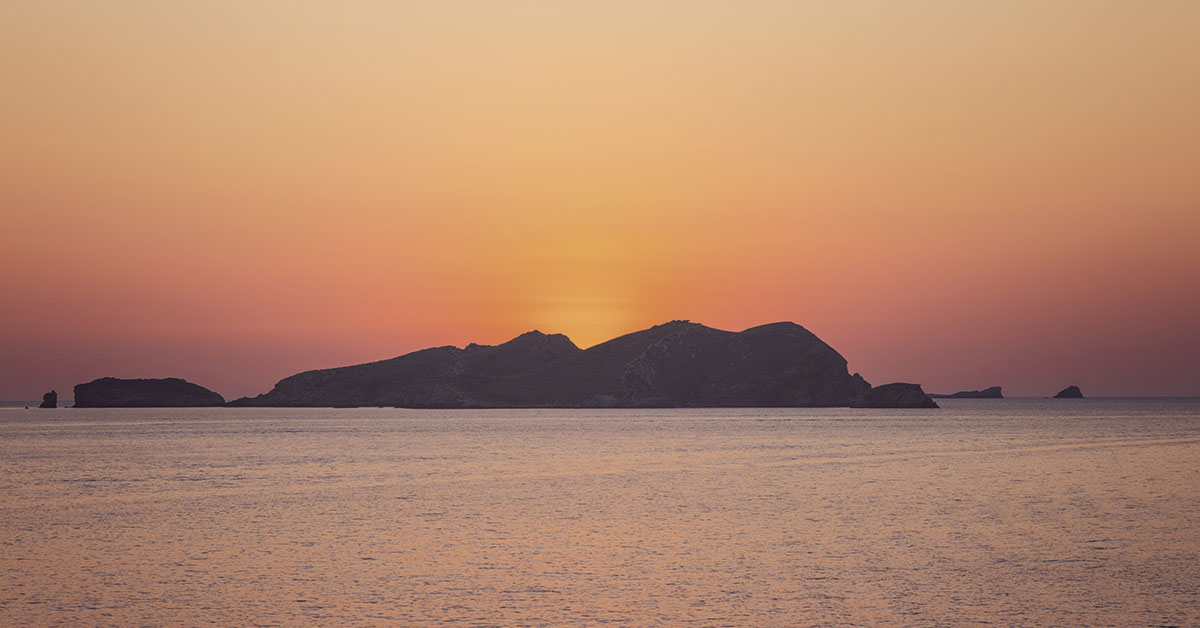
Sa Conillera, protagonist of the Portmany skyline
Those who have watched the sunset from the bay of Sant Antoni will recognise Sa Conillera. With about one hundred hectares and more than two kilometres in length, it is one of the largest islets in the Pitiusas.
Different seabirds nest here, including the Balearic shearwater, and there is also a particular population of Pitiusan lizards. Its lighthouse, installed in the nineteenth century, completes one of the most characteristic images of the west coast.
Ses Bledes and S'Illa des Bosc, small treasures of the west
Further west we find Ses Bledes, a small archipelago whose name is related to a subspecies of wild chard known locally as bleda.
Despite their small size, they have an extraordinary natural wealth, with particular populations of lizards and, under the Mediterranean, important colonies of red gorgonian. In Na Plana there is also a small lighthouse that began to function as a maritime signal in 1927.
Closer to Ibiza is S'Illa des Bosc, opposite Platges de Comte. Remains of an ancient wall and ceramics dating back to the first century AD have been found here. small clues to the relationship that the inhabitants of Ibiza maintained with these territories throughout history.
Between Ibiza and Formentera: islands in the heart of Ses Salines
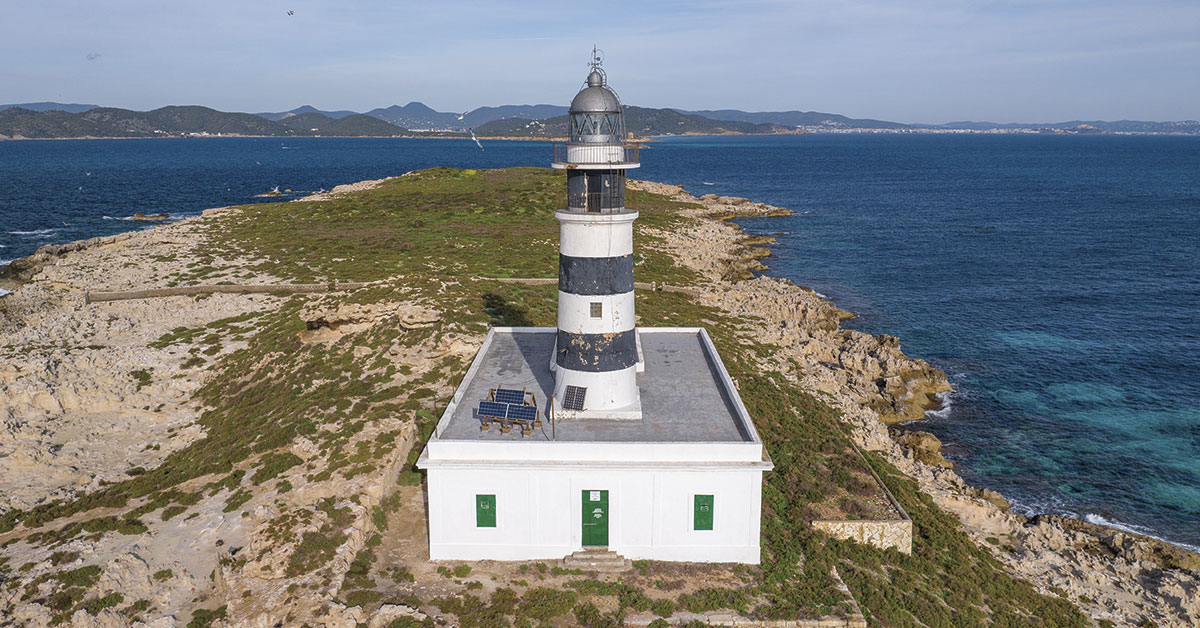
S'Espalmador and S'Espardell, protected nature
To the north of Formentera we find S'Espalmador, a territory of approximately 137 hectares integrated into the Natural Park of Ses Salines d'Eivissa i Formentera. Its white sand beaches and transparent waters create a paradisiacal picture, although we are facing a particularly sensitive environment that we must treat with the utmost respect.
Although it may seem close, it is not advisable to cross from Formentera on foot or by swimming, as the currents of Es Trocadors can be dangerous. The well-known mud baths in its lagoon are also not allowed.
About four kilometres away we find S'Espardell, also integrated into the natural park, with a coastline mainly cliff, a lighthouse at its northern end and remains of an old defensive tower.
S'Illa des Penjats and the first lighthouse in the Pitiusas
In Es Freus we find S'Illa des Penjats, the southernmost islet of Ibiza and the protagonist of one of the most disturbing legends of the Pitiusas.
According to tradition, in the past there was a scaffold where the bodies of executed pirates and corsairs were exposed as a warning to other ships. There is no historical certainty that it really happened, but history was forever linked to the islet.
What we do know is that its lighthouse, completed in 1855, was the first in the Pitiusas.
For decades it was inhabited by families of lighthouse keepers who marked this complicated maritime passage until its automation in 1929.
Descubreibiza.com makes it easy for you
The islets are part of the landscape, biodiversity and also of the stories of the Pitiusas. Discovering them from the coast or during a respectful navigation is another way of understanding the close relationship of Ibiza and Formentera with the Mediterranean.
In Descubreibiza.com you will find beaches, routes, natural spaces, villages, culture and many other proposals to continue exploring the island.
In addition, you can count on Lali, our AI-based chatbot available in multiple languages, and Cicerone, our intelligent planner to create routes adapted to your tastes.
Experience, enjoy and discover Ibiza at your own pace!

